Quality Control
Total Package Oxygen is the single most important technical specification for beer freshness. Here is what it means, how it is measured, and what levels to expect from a quality brewery.
Published 17 June 2026 · By the JINPAI Brewery production team
Dissolved Oxygen (DO) is the concentration of oxygen molecules dissolved directly in the liquid beer at a given moment, expressed in parts per billion (ppb) or parts per million (ppm). It is routinely measured at the bright beer tank — after filtration and carbonation, before the filling line. A well-run lager operation targets bright beer DO below 20 ppb before it ever touches a package.
Total Package Oxygen (TPO) is the broader figure. It is the sum of all oxygen present in the sealed container: the dissolved oxygen in the beer itself, plus the oxygen remaining in the headspace gas above the liquid. When a can is seamed or a bottle is capped, whatever oxygen is in that headspace gets trapped along with the beer and continues to react with it for the entire shelf life. TPO is calculated by combining these two contributions and expressing the result as a single ppb value referenced to the total liquid volume of the package.
The distinction matters because a brewery can achieve excellent bright beer DO yet still deliver high-TPO packages if headspace purging is inadequate. Many operators measure only DO and consider the job done. TPO is the honest number — it is what the beer actually experiences from seal to glass.
Oxygen picks up beer at multiple points in the process, and each one contributes to final TPO. Understanding the entry points is how a brewer builds a low-TPO outcome from the start rather than chasing it at the seamer.
This is the baseline contribution. Beer picks up dissolved oxygen during filtration, transfers, and carbonation if those operations are not conducted under CO2 blanket or counter-pressure. Each transfer through an improperly purged line or over-agitated pump adds a few ppb that compound downstream. Tanks should be CO2-purged before transfer and maintained under positive CO2 pressure throughout the fill run. Target: under 20 ppb at the bright beer tank outlet.
A 330 ml can with a 6 ml headspace at atmospheric air composition contains roughly 1,200 ppb of oxygen referenced to the liquid volume — catastrophic for shelf life. Modern filling lines purge each empty can with CO2 immediately before the fill head descends, and the filling is done under counter-pressure to suppress foaming and minimize air entrainment. A well-executed pre-purge can reduce headspace oxygen below 50 ppb contribution. The time between fill and seam must also be minimised: every second the open can sits exposed to air is oxygen ingress.
Properly seamed aluminium cans are essentially impermeable to oxygen. Bottles with crown caps are nearly as good. The risk here is quality of the seam or cap application: a double-seam that is out of specification on seam thickness or tightness, or a crown cap that is not fully sealed, allows slow oxygen ingress over weeks. This shows up in the field as accelerated staling in apparently normal-looking packages. Seam quality inspection — torn-down seam measurement, at minimum two-per-shift — is not optional.
The primary staling pathway is the oxidation of Maillard reaction products formed during wort boiling. Melanoidins and other carbonyl precursors in fresh beer react with oxygen to produce a spectrum of staling compounds. The most important is trans-2-nonenal (E-2-nonenal), a lipid oxidation product with a characteristic cardboard, papery character detectable by trained tasters at threshold concentrations below 0.1 ppb in beer. Once formed it does not degrade — it only accumulates. A fresh lager at 3 ppb trans-2-nonenal tastes cardboard-free; by 6 ppb it is perceptibly off; at 12 ppb it is plainly stale.
Other oxygen-mediated changes include the oxidation of iso-alpha acids (the bittering compounds from hops), which shifts the bitterness from clean and lingering toward harsh and astringent. Sulphur compounds can oxidize to produce rubbery or caramelized off-notes. In beers with added functional ingredients — peptides, botanical extracts — oxygen can degrade the active compounds before the beer is even consumed, undermining the very reason the ingredient was added.
The Arrhenius equation describes the temperature dependence of these reactions precisely: every 10 °C rise in storage temperature approximately doubles the rate of staling reactions. A beer stored at 30 °C degrades as fast in one month as the same beer held at 20 °C does in two months, or at 4 °C does in eight months. This is why cold-chain storage is not a premium option but a technical requirement for export beer with a 9–12 month target shelf life — and why TPO matters more, not less, for ambient-temperature distribution in hot climates.
There is no universal "acceptable" TPO. The right target depends on beer style, storage conditions and the commercial shelf life required. The numbers below represent the performance boundaries that separate serious industrial production from commodity filling.
| Beer category | Target TPO | Notes |
|---|---|---|
| Premium lager, 9–12 month shelf life | < 50 ppb | Export standard, cold-chain or ambient premium distribution |
| Hop-forward beer (IPA, pale ale) | < 30 ppb | Hop aroma is especially vulnerable to oxidation; lower target necessary |
| Functional / ingredient beer | < 30 ppb | Protect active ingredient integrity; peptides and botanicals are oxygen-sensitive |
| Standard mainstream lager, 6-month shelf life | < 100 ppb | Borderline for ambient warm-climate distribution; 50–80 ppb is preferable |
These are package TPO figures, not bright beer DO figures. A 50 ppb TPO target is achieved by holding bright beer DO below 20 ppb and headspace oxygen contribution below 30 ppb — both of which require disciplined line practice and verified purge protocols, not just good intentions.
Modern oxygen measurement in a brewery uses optical luminescence sensors rather than older electrochemical (Clark electrode) technology. The two platforms most commonly found in serious production environments are Hach Luminox (widely used for in-line bright beer and process DO measurement) and Anton Paar Orbisphere (the de facto standard for both process DO and inline TPO measurement). Both use fluorescence quenching: a dye patch excited by an LED emits light at an intensity inversely proportional to oxygen concentration, with no consumable membrane or electrolyte to drift over time.
For TPO specifically, inline measurement directly after the seamer is the most operationally useful configuration. An Orbisphere TPO sensor mounted on a by-pass loop from the filler carousel samples each package within seconds of sealing. If a package exceeds the TPO alarm setpoint — say 80 ppb for a line running a 50 ppb target, to allow a margin for measurement uncertainty — the operator is alerted in real time and that group of cans can be quarantined before palletizing. This is not luxury instrumentation. On a 36,000-can-per-hour line, a process upset that runs unchecked for ten minutes produces 6,000 out-of-spec cans. An inline TPO meter pays for itself by catching that before it reaches the warehouse.
When evaluating an OEM brewery for export production, ask these specific questions: What is your documented bright beer DO capability at the filler inlet? What is your typical headspace oxygen contribution per package type? Do you measure TPO inline or by sample from finished packages? What is your alarm setpoint and your action limit? Can you provide TPO run data from a recent production of the same package format? A brewery that cannot answer these questions with actual numbers — not reassurances — has not built its process around oxygen control.
Dissolved Oxygen (DO) measures oxygen dissolved in the liquid beer at a single point in time — typically measured in the bright beer tank before filling, in ppb or ppm. Total Package Oxygen (TPO) is the total amount of oxygen present in the sealed package: the sum of dissolved oxygen in the beer plus the oxygen in the headspace gas at time of sealing. TPO is the number that matters for shelf life prediction because it accounts for all the oxygen the beer will be exposed to in the can or bottle.
Low TPO requires a sequence of oxygen-exclusion steps: purging the bright beer tank with CO2 before transfer, transferring beer under CO2 pressure, purging the can or bottle with CO2 before the fill head contacts it, filling under counter-pressure to minimize turbulence, and sealing immediately after fill to minimize headspace residence time. Modern inline TPO meters measure each can within seconds of sealing and can alert the line operator if a package exceeds the spec threshold.
For ambient-temperature mainstream lager with a 6-month shelf life, 100 ppb is borderline — the beer will likely remain within spec but may show early staling signs (slight papery character) by month 4–5. For premium beer targeting 9–12 months, 100 ppb is too high; you want below 50 ppb. For hop-forward or functional beer where ingredient integrity matters, target below 30 ppb. Ask any OEM brewery for their documented TPO capability before committing to a production run.
TPO is not a detail for quality engineers to discuss in isolation. It is a commercial specification with a direct impact on whether your beer reaches your customers tasting as it should. A brewery that controls bright beer DO to under 20 ppb, purges headspace to under 30 ppb oxygen contribution, measures TPO inline, and can hand you the run data is running a serious process. One that measures only DO at the tank outlet, or cannot produce run data, is not.
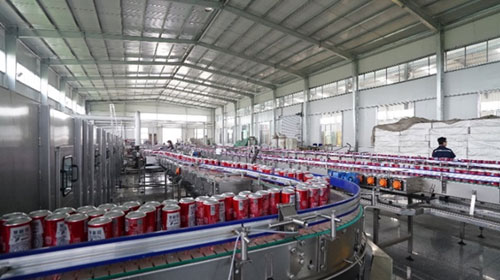
JINPAI operates 36,000-can-per-hour filling lines in Shandong with inline oxygen measurement at the filler and in the bright beer loop. Our export team can provide documented TPO capability data for any package format we run. If you are developing a product for a market where shelf life and freshness on arrival matter — which is every serious export market — send us the brief and we will respond with specs, sample availability and production capability within 24 hours.
